
Your home’s gutter system is its primary defense mechanism against the destructive forces of nature. In Rock Hill, SC, where the weather dramatically shifts from sweltering, highly humid summers to torrential, unpredictable seasonal downpours, a functioning gutter system is absolutely vital. However, the exact environmental factors that make York County beautiful—the sprawling oak canopies, towering Carolina pines, and lush vegetation—also make it a highly demanding environment for exterior property maintenance.
When debris from these trees combines with our region’s dense humidity, your gutters can quickly transform from an efficient water-management system into a heavy, stagnant, and highly destructive trench of rotting organic matter. Because a home’s foundation, siding, and roof structure are inherently vulnerable to standing water, maintaining clear downspouts and seamless flow requires a highly specialized, proactive approach.
Failing to properly maintain your rainwater drainage system can lead to flooded crawlspaces, deeply rotted wood framing, cracked foundations, and incredibly costly structural repairs. This comprehensive guide outlines the optimal seasonal schedules, critical storm preparation techniques, and the severe risks of skipping your professional gutter clean-out, helping you understand exactly what is required to safely protect your property’s integrity.
Table of Contents
What Is the Recommended Schedule for a Gutter Clean-Out in Rock Hill?
When searching for the optimal home maintenance schedule, Rock Hill homeowners frequently ask exactly how often a professional gutter clean-out is required to prevent water damage.
For most homes in Rock Hill, SC, the recommended schedule for a thorough gutter clean-out is at least twice a year—specifically in the late spring and late fall. However, this is not a one-size-fits-all rule. Your specific property’s landscape heavily dictates your required maintenance frequency.
- The Standard Schedule (Twice Annually): If your home has standard landscaping with trees situated a moderate distance from the roofline, a late spring clean-out (to remove pollen, oak tassels, and seed pods) and a late fall clean-out (to remove fallen autumn leaves) is generally sufficient.
- The High-Canopy Schedule (Three to Four Times Annually): If your property is heavily shaded by towering pine trees, mature oaks, or sweetgum trees that physically overhang your roofline, a biannual schedule is woefully inadequate. Pine needles fall continuously year-round and instantly interlock to form dense, impenetrable dams. In these environments, an advanced maintenance schedule—including early spring, mid-summer, late fall, and winter clean-outs—is required to ensure continuous water flow.
Understanding these localized environmental timelines is not just about keeping the perimeter of your roof looking neat; it is the definitive key to ensuring your property survives the heavy Carolina storm seasons without sustaining irreversible water damage.
Why the Carolina Climate Demands Frequent Gutter Maintenance
The traditional concept of merely cleaning gutters “when the leaves fall” simply does not apply to the unique, highly active ecosystem of York County. Our climate actively accelerates the degradation of your home’s exterior if left unchecked.
The Humidity and Organic Growth Factor
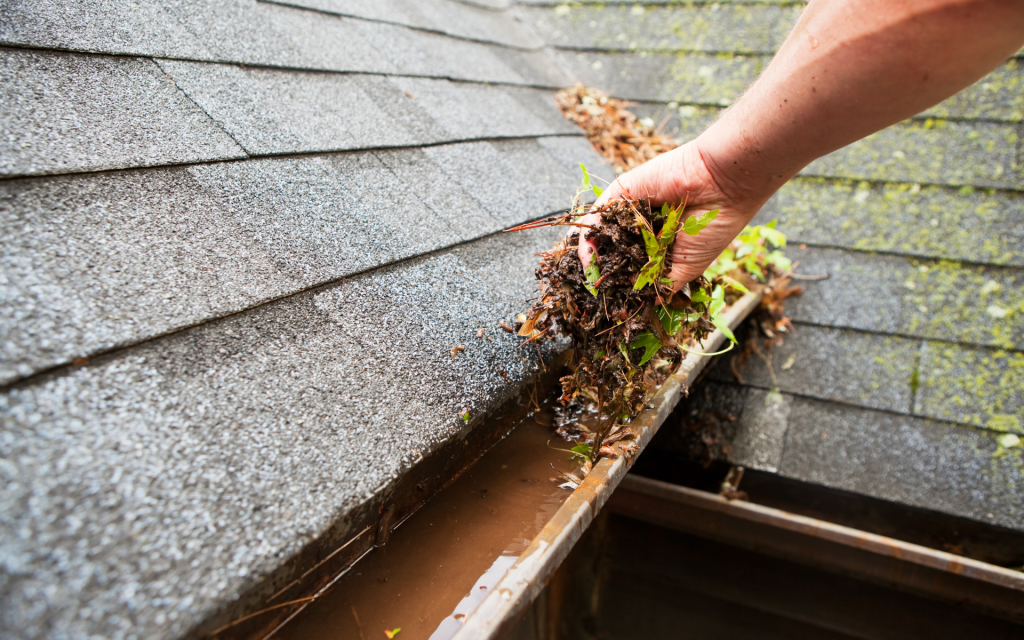
In Rock Hill’s intensely humid environment, debris trapped in your gutters rarely dries out. When leaves, twigs, and pollen accumulate, they create a dense, sponge-like compost pile. The relentless Carolina humidity ensures this debris remains perpetually soaked, quickly fostering aggressive organic growth. Algae, thick moss, and even small weeds will literally take root inside your gutters. This heavy, wet sludge adds immense, localized weight to the aluminum channels, pulling them away from the fascia board and completely ruining the structural pitch required for water to drain toward the downspouts.
The Menace of Pine Needles and Oak Tassels
While broad leaves are easy to spot, the real hidden threats in South Carolina are pine needles and oak tassels. In the spring, oaks release millions of stringy tassels that coat your roof and wash directly into your gutters during the first rainstorm. These tassels turn into a thick, mud-like paste that clings to the bottom of the aluminum channels. Similarly, pine needles are thin enough to wash down into the elbows of your downspouts, where they cross over each other to form an internal, invisible blockage that acts exactly like a beaver dam, resulting in immediate overflow during the next major weather event.
The Severe Risks of Ignoring Your Gutter Clean-Out
The most common, and undeniably the most expensive, mistakes Rock Hill homeowners make involve treating a gutter clean-out as an optional aesthetic chore rather than a critical structural necessity.
Foundation Damage and Flooded Crawlspaces
The primary function of a gutter system is to channel thousands of gallons of destructive rainwater safely away from your home’s foundation. When gutters are clogged, water violently cascades directly over the edge, pooling in massive quantities right at the base of your house. In Rock Hill, the heavy red clay soil absorbs this water, expanding and exerting immense hydrostatic pressure against your foundation walls. Over time, this pressure inevitably causes the concrete or cinderblock to crack, allowing raw groundwater to flood your crawlspace or basement, which aggressively ferments into toxic black mold.
Rotted Fascia Boards and Roof Damage
Gutters are mounted directly to your home’s fascia—the wooden board running horizontally just under the edge of your roof. When a gutter is packed to the brim with wet debris, the standing water has nowhere to go but backward. It consistently wicks up into the porous wood of the fascia board and the internal roof trusses. This invisible, constant water intrusion quietly ferments into highly destructive internal wood rot over the following months. By the time you notice the paint peeling on the outside, the structural wood holding your roof together has likely disintegrated completely.
The Threat of Pest Infestations
Clogged, poorly maintained gutters create the ultimate breeding ground for highly undesirable pests. Stagnant, nutrient-rich water sitting in a clogged gutter is the absolute perfect incubator for mosquitoes, allowing them to swarm your outdoor living spaces during the humid Carolina summers. Furthermore, the damp, rotting leaf debris provides an ideal nesting environment for destructive carpenter ants, aggressive wasps, and even rodents seeking elevated shelter close to your attic.
Proper Storm Preparation: Securing Your Home Before Heavy Rainfall
Rock Hill is heavily prone to sudden, violent thunderstorms in the summer and the lingering, torrential downpours of late-season tropical storm systems. Proper storm preparation is absolutely crucial.
Flushing and Verifying the Downspouts
A gutter channel that is perfectly clean is still completely useless if the downspout is clogged. Proper storm preparation requires more than just scooping out the leaves. A professional gutter clean-out mandates that high-volume water is manually flushed down every single downspout. This forcefully tests the entire system, ensuring there are no hidden internal blockages, bird nests, or impacted pine needles within the elbows of the piping. If water is not aggressively ejecting from the bottom of the downspout, the home is entirely unprotected for the next major storm.
Inspecting for Proper Pitch and Sagging
Water obeys the laws of gravity. Your gutters must be precisely angled (pitched) toward the downspouts for water to flow efficiently. However, the extreme weight of wet debris, combined with expanding and contracting metal during dramatic seasonal temperature shifts, frequently causes the mounting brackets to fail. This results in the gutter sagging in the middle. During a professional clean-out, technicians must visually inspect the water flow to ensure it actively drains rather than pooling in the center of the channel, re-securing the hardware to the fascia where necessary.
Why DIY Gutter Cleaning is a Dangerous and Ineffective Chore
Many homeowners attempt to tackle gutter maintenance on a Saturday afternoon with a ladder and a pair of gloves. However, this is heavily discouraged by property maintenance experts for several critical reasons.
The Severe Safety Risks of Ladder Work
Cleaning your own gutters is inherently, fundamentally dangerous. Attempting to balance on a tall extension ladder while reaching awkwardly to scoop out wet, heavy sludge frequently results in devastating falls. The uneven ground surrounding most Rock Hill homes, compounded by wet grass or mud, makes ladder instability a severe threat. Professional technicians are rigorously trained in ladder safety, utilize specialized stand-offs to protect your siding, and often employ heavy-duty, ground-based vacuum systems to mitigate these severe risks entirely.
Incomplete Debris Removal
When a homeowner cleans their own gutters by hand, they typically only remove the large, visible debris. They invariably leave behind the thick layer of shingle grit, mud, and organic sludge coating the bottom of the channel. Furthermore, without high-volume flushing equipment, DIY attempts almost never properly clear the highly problematic internal clogs located deep inside the downspout elbows. The result is a system that looks clean from the ground but will still catastrophically fail during the next heavy rainstorm.
Professional Tip: Integrating Gutter Health with Roof Maintenance
A true professional understands that your home’s exterior acts as a cohesive ecosystem. A gutter clean-out should never be viewed in isolation. When technicians are accessing your roofline, it is the perfect time to assess the overall health of your asphalt shingles. If a massive amount of ceramic shingle grit is found sitting densely in the bottom of your gutters, it is a definitive, early warning sign that your roof is nearing the end of its structural lifespan. Combining your seasonal gutter maintenance with a routine roof inspection ensures that minor vulnerabilities are rapidly addressed long before they evolve into catastrophic internal leaks.
Protect Your Home’s Structural Integrity with Carolina Power Wash
Don’t risk permanently damaging your home’s most vital protective barriers, flooding your foundation, or endangering your personal safety with improper, highly dangerous DIY ladder work.
Your home’s rainwater management system requires a highly specialized, methodical touch; neglecting it can lead to deeply rotted wood framing, cracked foundations, voided exterior warranties, and incredibly costly structural replacements. At Carolina Power Wash, we utilize industry-leading techniques to perform an exhaustive, complete gutter clean-out, keeping Rock Hill’s homes structurally invincible against the harsh Southern elements. Our comprehensive approach ensures that not only is the bulky organic debris safely eliminated, but every single downspout is forcefully flushed, tested, and guaranteed to flow freely.
We intimately understand that your home is your single most significant financial investment. That’s exactly why our highly trained technicians prioritize precision, property protection, and meticulous care. For over a decade, we’ve been the trusted, local choice for York County homeowners who simply refuse to compromise on quality, integrity, or safety.
Give your home the ultimate professional care it deserves and protect your foundation from the next Carolina storm. Contact Carolina Power Wash today to schedule your professional gutter clean-out and discover the massive difference true, expert property maintenance can make for your home’s longevity and peace of mind.